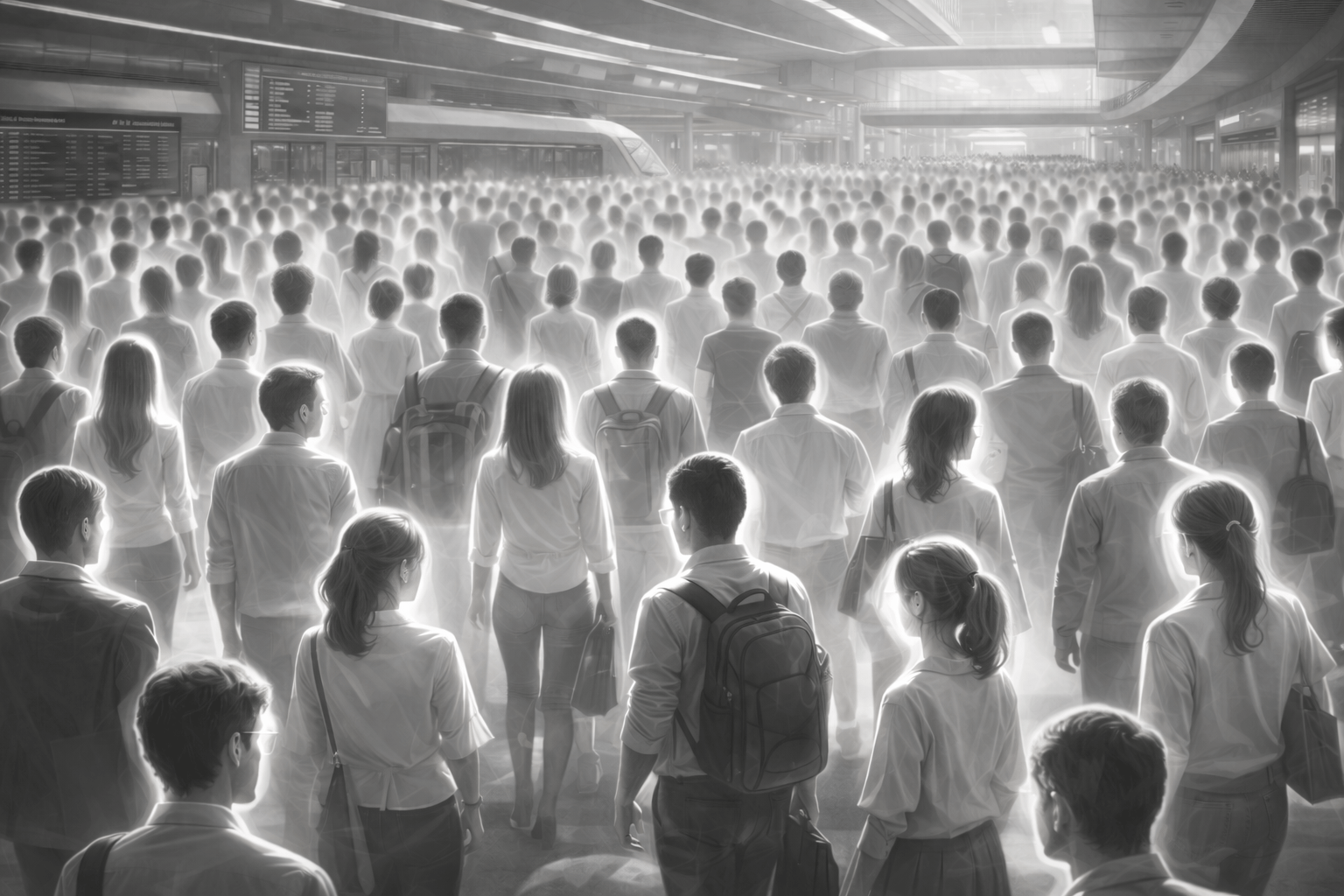
I did not plan to spend my evening reading old history archives, but the university library makes it easy to wander into centuries you never meant to visit. One record led to another, and before long I was deep inside stories from a time when people were treated differently because of the colour of their skin.
At first I thought I was misunderstanding the text. The idea felt too strange to be real. Whole systems built around appearance. Opportunities decided by shade. Fear created by difference. I read the same lines more than once, trying to place them inside the world I know, and nothing quite fit. By the early years of the twenty third century, most of that had already begun to change. The first universal neural-tuned contact lenses were developed for public service workers. Police officers, doctors, transport pilots, and other civil servants wore them so that everyone they interacted with appeared in a calm, harmonised human form. The purpose was simple. Remove immediate visual bias so decisions could be made with clarity. The policy was debated at first. Some believed it would erase identity. Others believed it would end centuries of visible division. Over time, the results spoke quietly. Conflict linked to appearance reduced. Trust in public services increased and everyday interactions became easier.
What began as a requirement slowly became a choice. Now almost everyone wears the lenses. We still look like ourselves. Our voices, expressions, and movements remain our own and the lenses do not make people identical. They simply soften the old visual signals in skin color that once caused instant judgment. It is such an ordinary part of life that most of us rarely think about it. While I was reading, Ava was across the room organising notes for tomorrow’s coordination lab. She looked up once and asked what I was studying. I told her it was history, and she gave me the patient look people give when they think you are doing something unnecessarily difficult. I kept reading anyway. The archives did not only describe discrimination. They also described something else that felt just as distant from our lives now. Even when people were constantly connected through early digital networks, many of them felt deeply alone. They spoke to thousands and were known by none. Friendships were counted in numbers and follower-count instead of presence. Loneliness was recorded as one of the most common emotional states of the time. That part stayed with me, because our century solved loneliness in a very gentle way through the use of Optional Social Visors.
Anyone can wear one when they feel bored, curious, or open to meeting someone new. Inside the visor is a quiet display where you type a few interests. Gardening. Skiing. Old-fashioned knitting. Music from a certain century. Walking without a destination. Then you step outside and go about your day. If another person nearby is wearing a visor with matching or similar interests, a soft light appears at the edge of your view. If both people keep walking, the light slowly becomes a gentle guide, turning into a small navigation path that can lead two strangers toward the same bench, the same café table, or the same stretch of riverside path. The visor has controls that lets one decide how much one would like to engage. You can tell if they are die-hard fans of an activity or at beginner stage.
The system broke down many of the silent barriers that once kept people apart, especially for those with quiet or introverted personalities who found ordinary social spaces difficult. Friendships formed slowly and naturally. Some people even met life partners this way. Over time, whole communities began holding weekly visor gatherings, where people arrived with shared interests already glowing softly in their field of view. Conversations started easily this way. It became normal to belong somewhere. I closed the archive when the lights shifted toward evening. Across the room, Ava had finally stopped working and was staring at the ceiling the way she does when her Node is sorting too many thoughts at once.
“History again?” she asked.
I nodded.
“Was it bad?”
“Only… very different,” I said.
She seemed satisfied with that answer.
“Let’s go grab something to eat,” I said to Ava as she smiled and reached for her backpack.