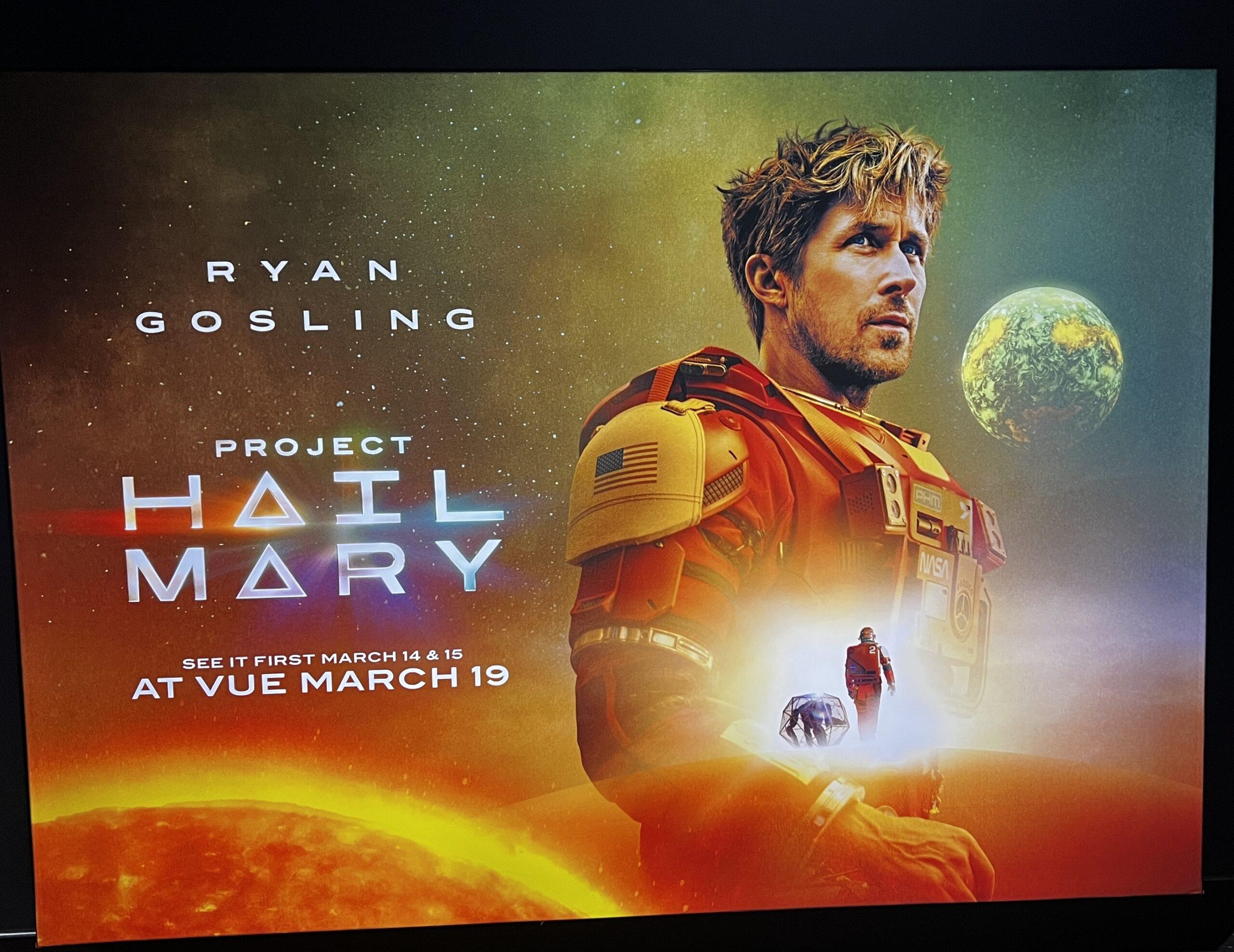
I remember exactly when I read Project Hail Mary. I had picked it up because I liked The Martian, but I didn’t expect to enjoy this one as much as I did. What stayed with me wasn’t just the story, but the science behind it. Astrophage, Tau Ceti, the Eridians… it all felt strangely believable, almost like reading a scientific mystery instead of pure science fiction.
So when I later found out that the book was being turned into a movie, I was genuinely happy. I had been looking forward to it for a long time, probably more than I realised. I ended up going to watch it on a Friday afternoon, on one of those low-energy days where you just want to sit somewhere dark and let the world slow down a bit. The cinema was almost empty. There couldn’t have been more than ten people there, which somehow made the whole experience feel even more personal.
As expected, the movie stayed very close to the book, which I appreciated. You can tell the filmmakers respected the source material, and that alone already puts it ahead of a lot of adaptations. The story follows Ryland Grace, played by Ryan Gosling, a science teacher who wakes up alone on a spacecraft and slowly realises he has been sent on a desperate mission to save Earth from a mysterious organism affecting the sun. At some point during the film, I looked sideways and saw my poor husband trying very hard not to fall asleep. I had to laugh to myself because I completely understood why. If you haven’t read the book, the story can feel a bit slow at times. A lot of the tension comes from problem-solving, not action, and if you don’t know what’s coming, it can feel like the film is taking its time getting there.
I think that’s why I walked out feeling slightly surprised. It was a good movie. A very good one, actually. But it didn’t blow me away the way I expected it to. The first thing I missed was the science. One of the reasons I loved the book so much was how deeply it went into the details; astrophage, the physics, the biology, the way Grace keeps figuring things out step by step. In the film, the science is there, but it’s lighter. Understandably so, because not everything translates well to the screen, but I did feel that some of the wonder of the book came from those explanations, and without them, the story loses a little of its magic.
The second thing that felt different to me was Eva Stratt, the German scientist in charge of the mission, played by Sandra Hüller. In the book she always came across as tough, yes, but also very controlled, very deliberate, almost intimidating in a quiet way. In the film she felt a bit bossier and harsher, more openly aggressive than I imagined her. And I definitely did not picture her as the kind of person who would suddenly break into Harry Styles’ Sign of the Times, even though I know the film used the song in the trailer and soundtrack. It worked cinematically, but it wasn’t how I had her in my head.
Aside from those two things, the movie really did stick to the book, and I respect that a lot. Ryan Gosling was surprisingly perfect for the role. He made Grace believable in that awkward, reluctant-hero way that the character needs. You could actually believe he was a teacher thrown into something far bigger than himself.
And Rocky…
Rocky was amazing!
Amaze. Amaze. Amaze.
If you’ve read the book, you know exactly what I mean. Bringing an Eridian to life on screen could have gone very wrong, but it didn’t. The friendship between Grace and Rocky is still the heart of the story, and the film gets that right. Even reviews I read online keep pointing out that the emotional connection between the characters is what makes the movie work, not just the space mission itself.
Overall, I’m glad I watched it.
I’m glad they made it.
And I’m happy it stayed true to the book.
